
What the chart shows
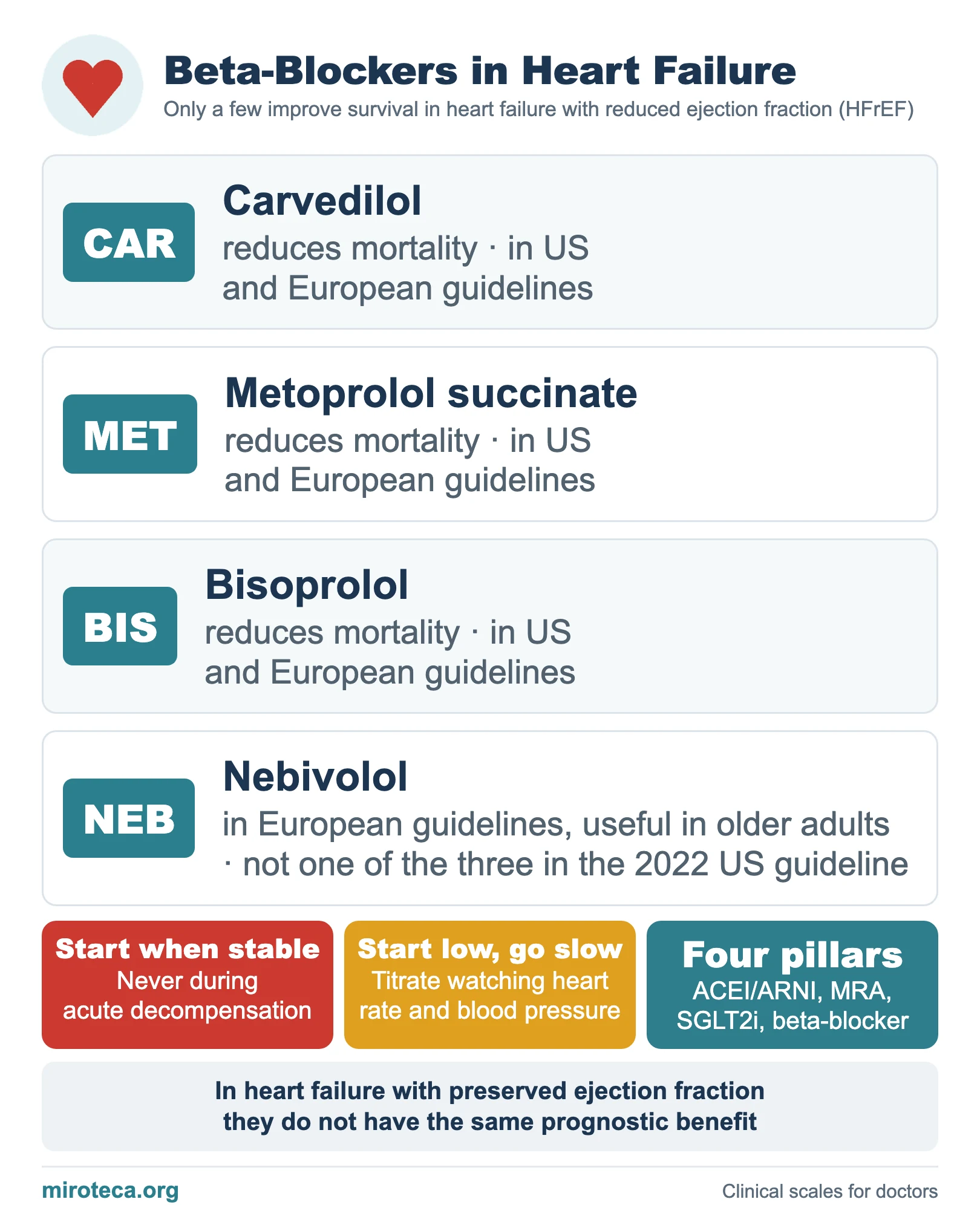
Not every beta-blocker works in heart failure with reduced ejection fraction (HFrEF). Only a few have been shown to reduce mortality, and they are part of the baseline treatment.
How the question is asked
The error the exam tries to catch is giving "any" beta-blocker in HFrEF; only the agents with proven benefit serve this purpose. The other classic trap is timing: they are never started during acute decompensation with congestion, but in a stable patient without volume overload.
They are started at low doses and increased slowly ("start low, go slow") while monitoring heart rate and blood pressure. Together with ACE inhibitors or ARNI, mineralocorticoid receptor antagonists (spironolactone, eplerenone) and SGLT2 inhibitors they form the "four pillars" that improve prognosis. In heart failure with preserved ejection fraction they do not have the same prognostic benefit.
US and European guidelines differ
The Spanish version of this chart, based on European practice, lists four: carvedilol, metoprolol succinate, bisoprolol and nebivolol (useful in older adults). The 2022 AHA/ACC/HFSA guideline recommends one of three beta-blockers proven to reduce mortality: bisoprolol, carvedilol or sustained-release metoprolol succinate. For US exams, the answer is those three. Related: NYHA classification.
Keep practicing
This page is the visual summary. To test yourself with real clinical reasoning, Medicinedle, a Wordle-inspired game, gives you one clinical case a day: guess the diagnosis in six tries, with a new clue after every miss. It is free.
Prefer quick questions? The clinical scores quiz gives you 5 case-based questions in about a minute, with the answer explained.