
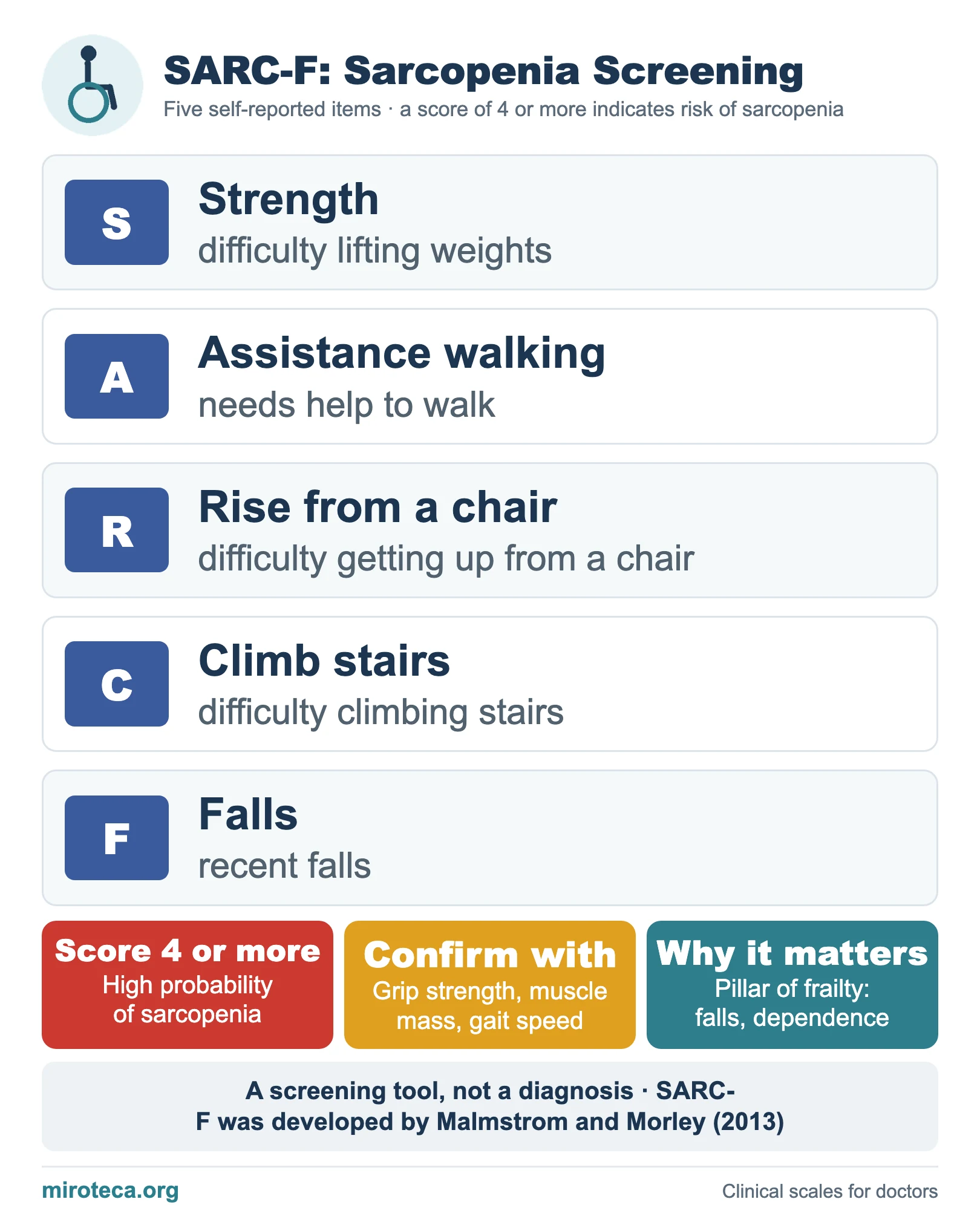
What the chart shows
SARC-F is a quick, self-reported questionnaire to screen for sarcopenia (loss of muscle mass and function) in older adults. Its appeal is that it is fast and needs no equipment, so it is used as a first filter. It was developed by Malmstrom and Morley (2013).
What it measures and how it is read
The 5 items: Strength, Assistance walking, Rise from a chair, Climb stairs and Falls. A score of 4 or more indicates a high probability of sarcopenia and calls for confirmation.
Confirmation is not done with the questionnaire but by measuring strength (hand-grip dynamometry), muscle mass (bioimpedance or DEXA) and physical performance (gait speed, the SPPB or the Timed Up and Go test). Why it matters: sarcopenia is a pillar of frailty in older adults and predicts falls, dependence and mortality; detecting it early allows intervention with resistance exercise and protein intake.
In exam questions
Short rules: SARC-F of 4 or more means suspected sarcopenia; it is a screening tool, and confirmation requires measuring strength and muscle mass; sarcopenia is a key component of frailty.
Keep practicing
This page is the visual summary. To test yourself with real clinical reasoning, Medicinedle, a Wordle-inspired game, gives you one clinical case a day: guess the diagnosis in six tries, with a new clue after every miss. It is free.
Prefer quick questions? The clinical scores quiz gives you 5 case-based questions in about a minute, with the answer explained.