
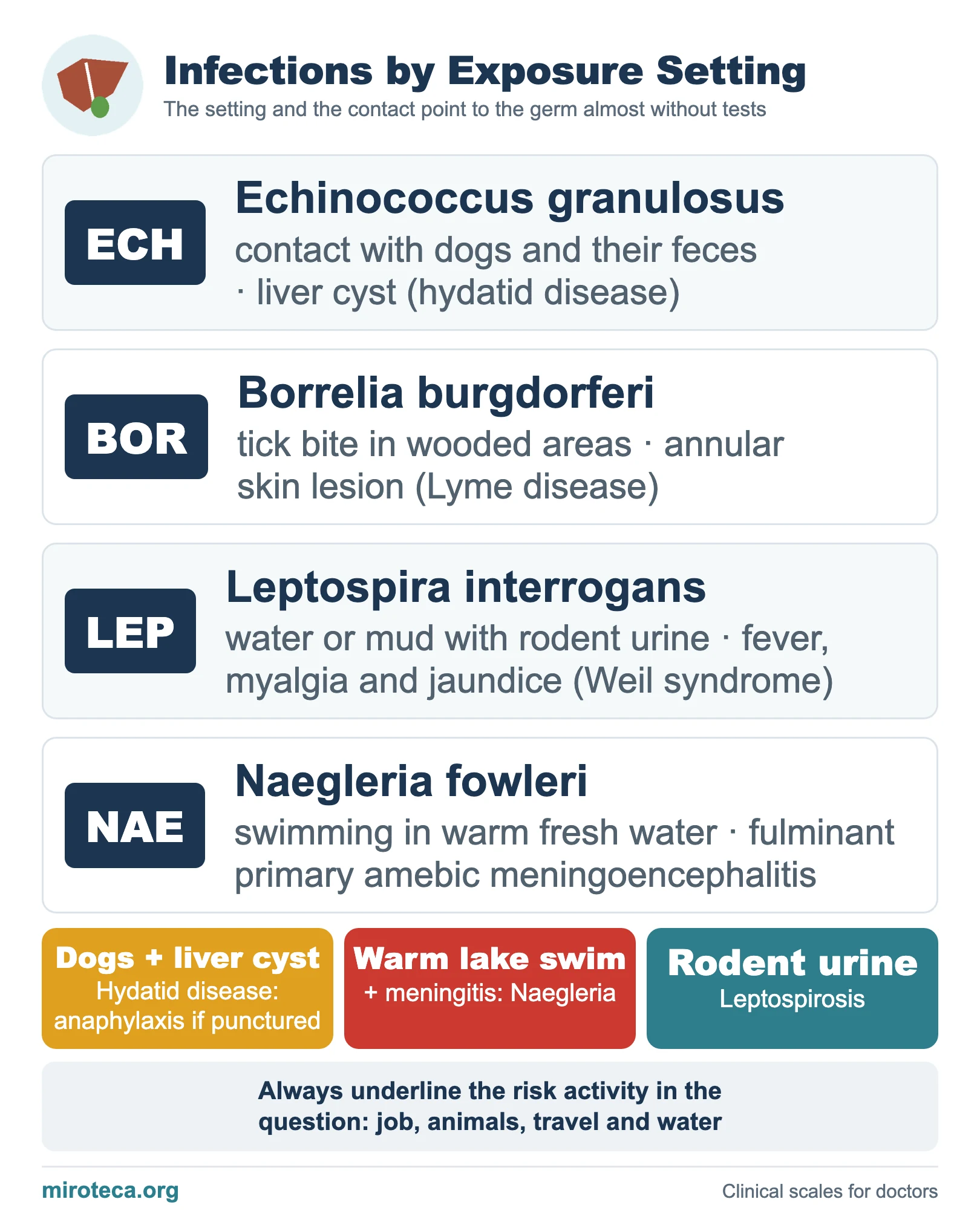
What the chart shows
Many questions hand over the germ through the epidemiological context: the animal, the water or the risk activity point to the diagnosis before the lab tests do.
Classic scenarios and their germ
Farmer or contact with dogs plus a liver cyst: Echinococcus granulosus (hydatid disease); careful, it should not be punctured without cover because of the risk of anaphylaxis. Hiker with an annular lesion after a tick bite: Borrelia burgdorferi (Lyme disease). Contact with water or mud with rodent urine: Leptospira (fever, myalgia and jaundice in Weil syndrome). Swimming in warm fresh water and fulminant meningoencephalitis: Naegleria fowleri.
In these questions the job, the animal, the water or the trip are worth more than the lab tests: read those details slowly, because they are often the only clue that separates the right answer from the distractors.
In exam questions
Short rules: liver cyst in a farmer means hydatid disease; meningitis after swimming in a warm lake means Naegleria. See also zoonoses by exposure and bite infections.
Keep practicing
This page is the visual summary. To test yourself with real clinical reasoning, Medicinedle, a Wordle-inspired game, gives you one clinical case a day: guess the diagnosis in six tries, with a new clue after every miss. It is free.
Prefer quick questions? The clinical scores quiz gives you 5 case-based questions in about a minute, with the answer explained.