
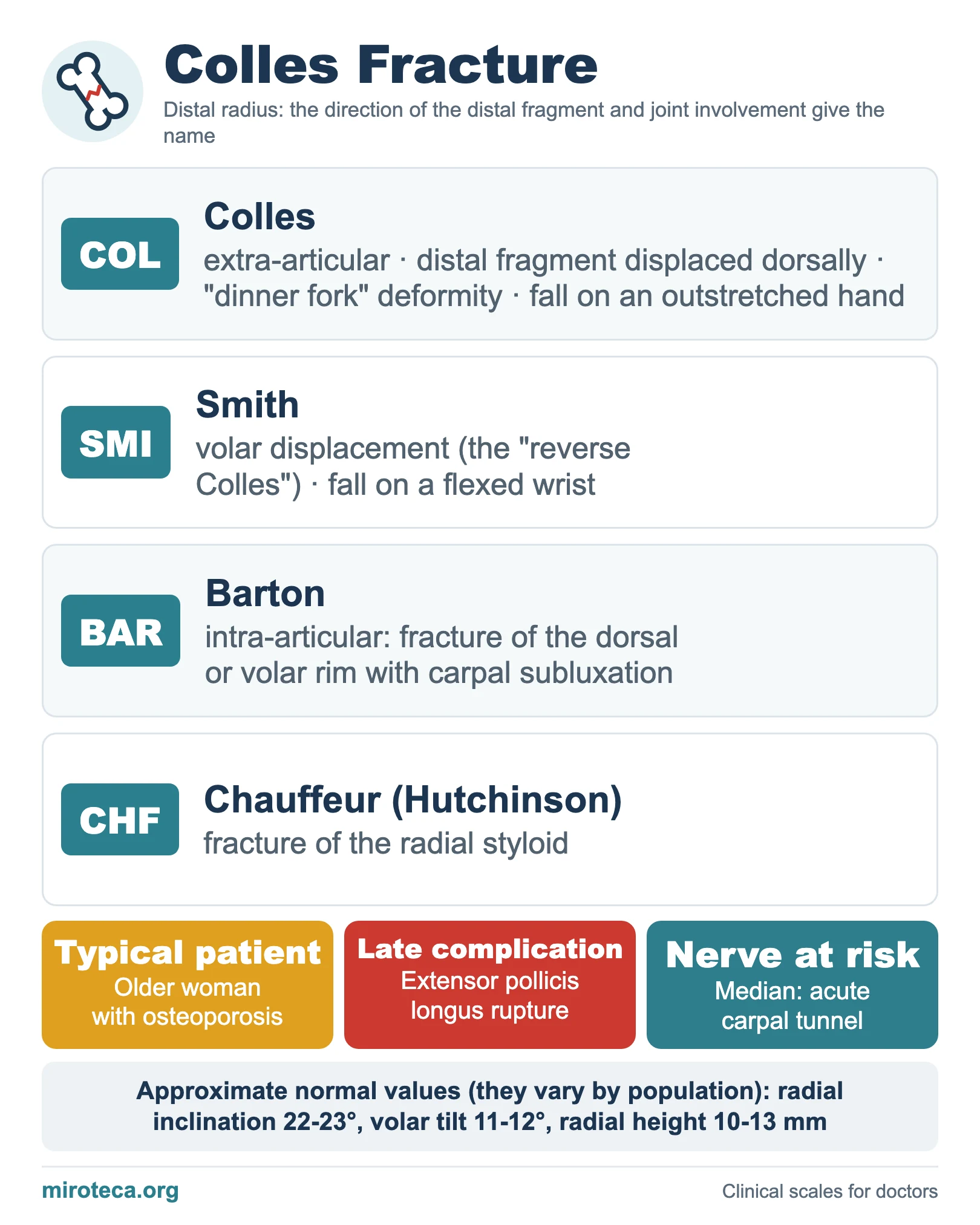
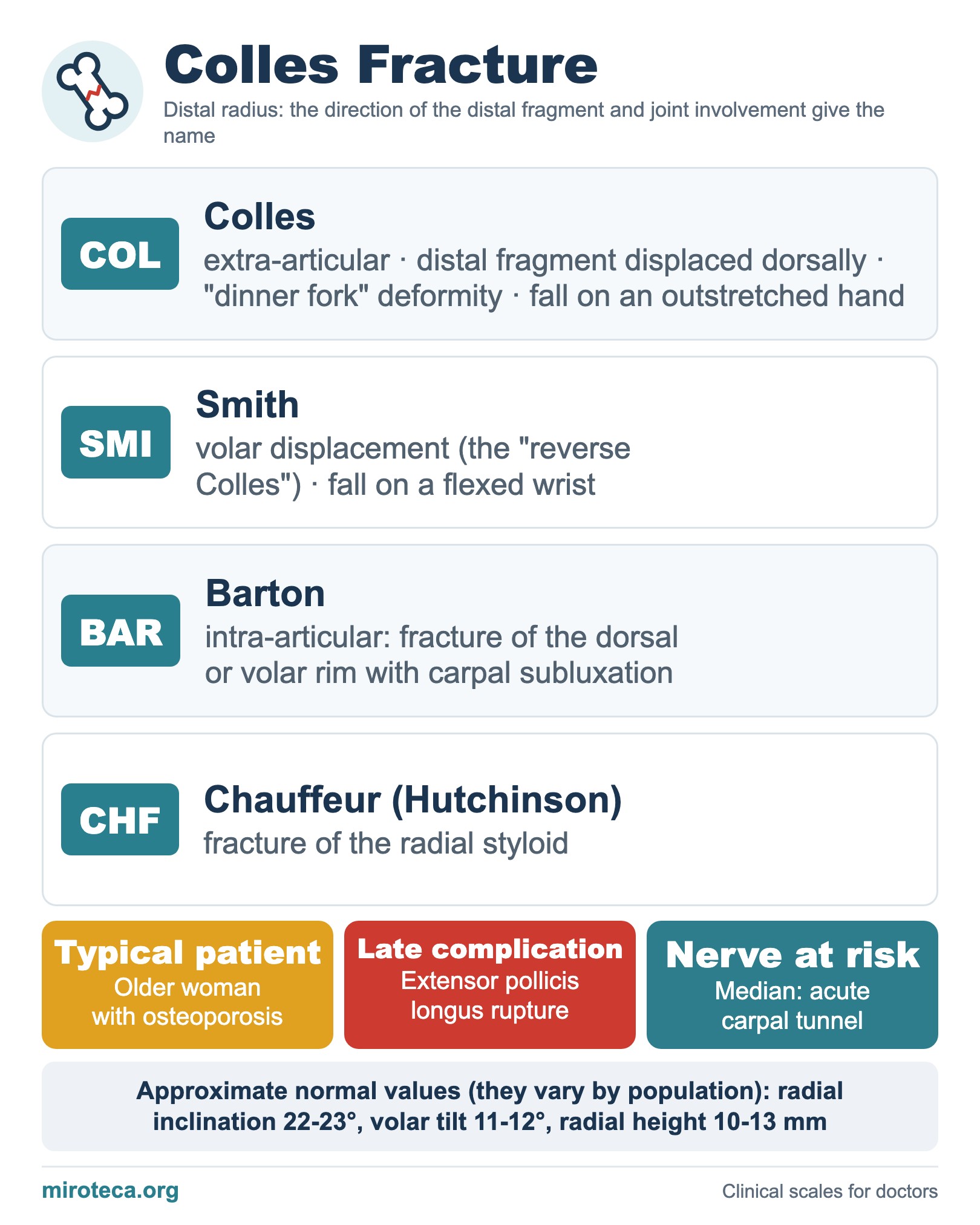
What the chart shows
The Colles fracture is the best-known distal radius fracture: extra-articular, with the distal fragment displaced and angulated dorsally. Seen from the side, the wrist shows the classic "dinner fork" deformity. It follows a fall on an outstretched hand with the wrist extended and is especially common in older women with osteoporosis. It is named after the Irish surgeon Abraham Colles, who described it in 1814.
The chart compares it with its "neighbors": the Smith fracture, with volar displacement (the "reverse Colles"); the Barton fracture, an intra-articular fracture of the dorsal or volar rim with carpal subluxation; and the Chauffeur or Hutchinson fracture of the radial styloid.
What to look at on the X-ray
On the posteroanterior and lateral views, radial inclination, volar tilt and radial height are assessed. Approximate normal values are about 22-23° of radial inclination, 11-12° of volar tilt and 10-13 mm of radial height, although they vary with the population studied.
Articular step-off weighs most on the outcome. As a guide, reference texts consider radial shortening of more than 5 mm, dorsal angulation of more than 20° or extensive dorsal or intra-articular comminution as signs of instability.
Complications that are asked
Late rupture of the extensor pollicis longus tendon, interestingly more common in minimally displaced fractures; median nerve compression (acute carpal tunnel syndrome); complex regional pain syndrome; and malunion.
In exam questions
Short rules: dorsal is Colles, volar is Smith; an intra-articular rim fracture is Barton; the radial styloid is Chauffeur. An older woman falling on an outstretched hand is the typical Colles case. See also Garden classification and Salter-Harris.
Keep practicing
This page is the visual summary. To test yourself with real clinical reasoning, Medicinedle, a Wordle-inspired game, gives you one clinical case a day: guess the diagnosis in six tries, with a new clue after every miss. It is free.
Prefer quick questions? The clinical scores quiz gives you 5 case-based questions in about a minute, with the answer explained.