
What the chart shows
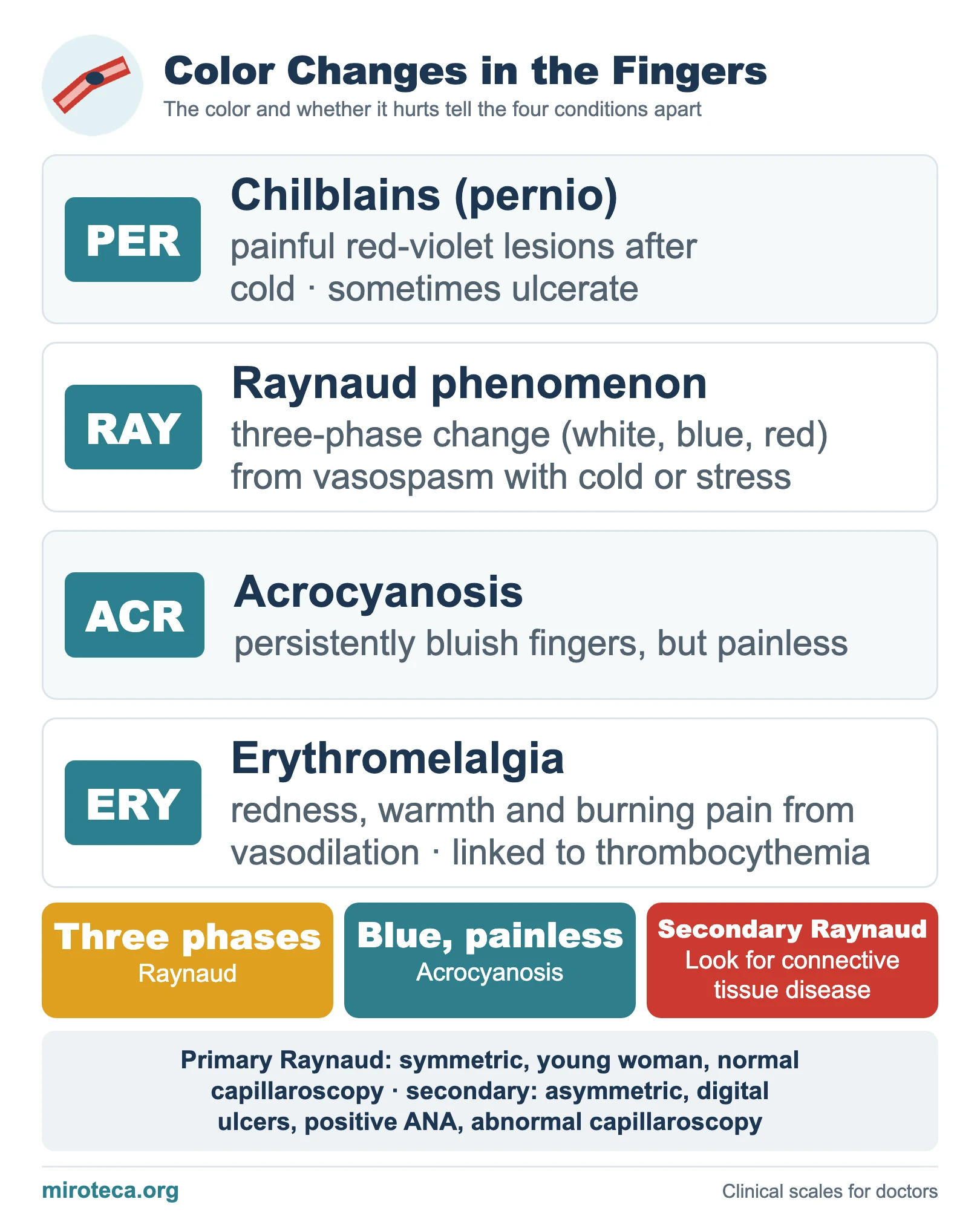
With color changes in the fingers after cold, two axes separate the four conditions: which color appears and whether it hurts.
How to tell them apart
Raynaud: three-phase change (pallor, cyanosis, redness) from vasospasm; if secondary, a connective tissue disease (scleroderma) must be sought. Chilblains (pernio): painful red-violet lesions after damp cold. Acrocyanosis: persistent, painless blue color, without phases. Erythromelalgia: red, hot and with burning pain; linked to thrombocythemia and myeloproliferative syndromes.
Clues to tell primary from secondary Raynaud: primary is symmetric, in a young woman, with normal capillaroscopy; secondary is asymmetric, with digital ulcers, positive antibodies (ANA) and abnormal capillaroscopy. That difference usually decides the question.
In exam questions
Short rules: a three-phase color change means Raynaud; persistent, painless blue means acrocyanosis; secondary Raynaud requires a search for connective tissue disease.
Keep practicing
This page is the visual summary. To test yourself with real clinical reasoning, Medicinedle, a Wordle-inspired game, gives you one clinical case a day: guess the diagnosis in six tries, with a new clue after every miss. It is free.
Prefer quick questions? The clinical scores quiz gives you 5 case-based questions in about a minute, with the answer explained.