
What the chart shows
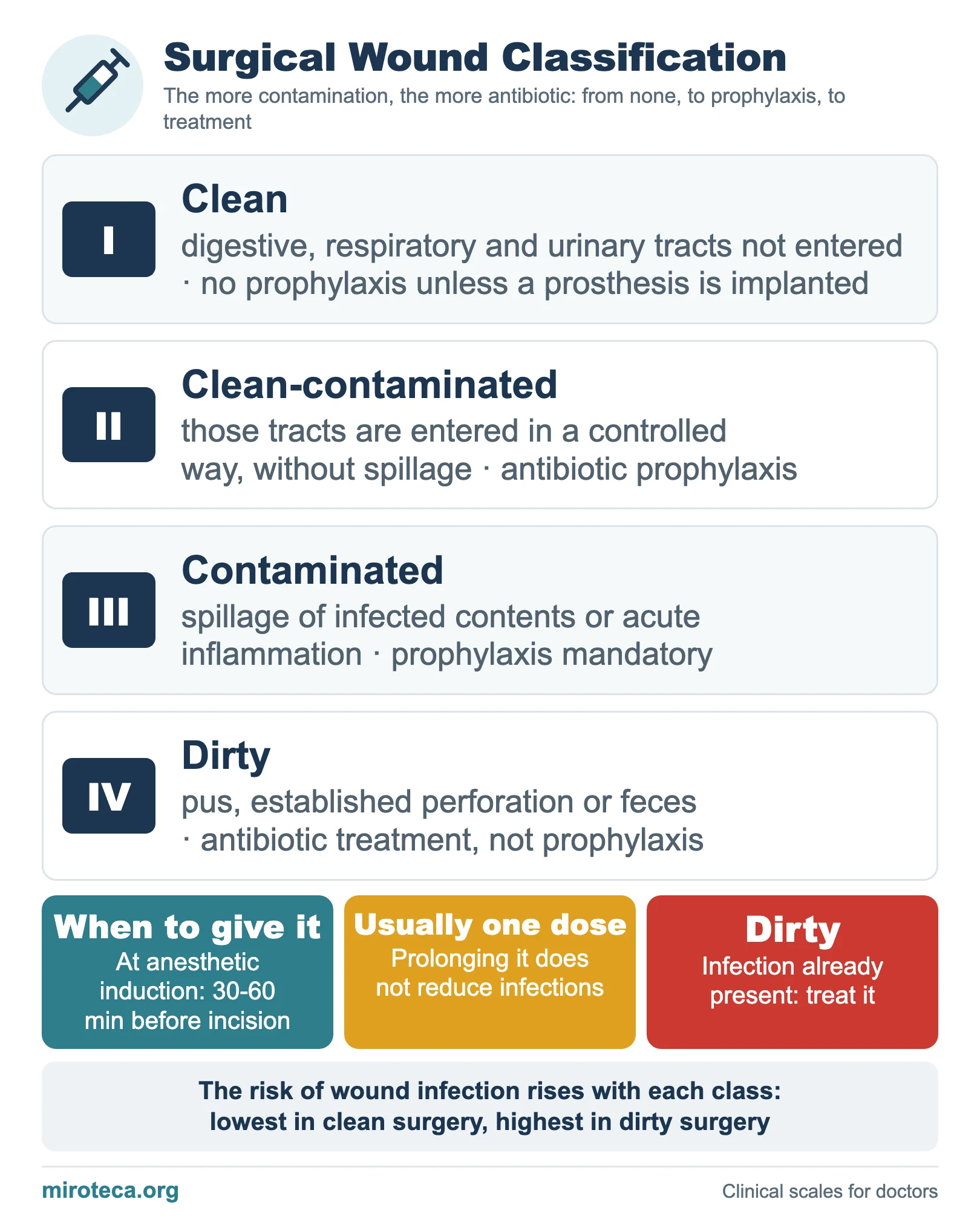
Classifying an operation by its degree of contamination decides whether antibiotic prophylaxis or treatment is needed, and estimates the risk of wound infection. The chart orders the four classes from clean to dirty.
From prophylaxis to treatment
Clean surgery does not enter the digestive, respiratory or urinary tract and needs no prophylaxis, unless prosthetic material is implanted (joint prosthesis, mesh, valve). Clean-contaminated surgery enters those tracts in a controlled way and needs prophylaxis. In contaminated surgery there is spillage of contents or acute inflammation, and prophylaxis is mandatory. Dirty surgery (pus, established perforation, feces) is no longer prophylaxis but antibiotic treatment, because the infection is already present.
Prophylaxis is given at anesthetic induction (30-60 minutes before the incision), so that levels are present at the moment of the cut. It is usually a single dose: prolonging it does not reduce infections and favors resistance. The risk of wound infection rises with each class.
In exam questions
Short rules: the more contamination, the more antibiotic; "dirty" means the infection is already there; prophylaxis is given at induction, not afterwards.
Keep practicing
This page is the visual summary. To test yourself with real clinical reasoning, Medicinedle, a Wordle-inspired game, gives you one clinical case a day: guess the diagnosis in six tries, with a new clue after every miss. It is free.
Prefer quick questions? The clinical scores quiz gives you 5 case-based questions in about a minute, with the answer explained.