
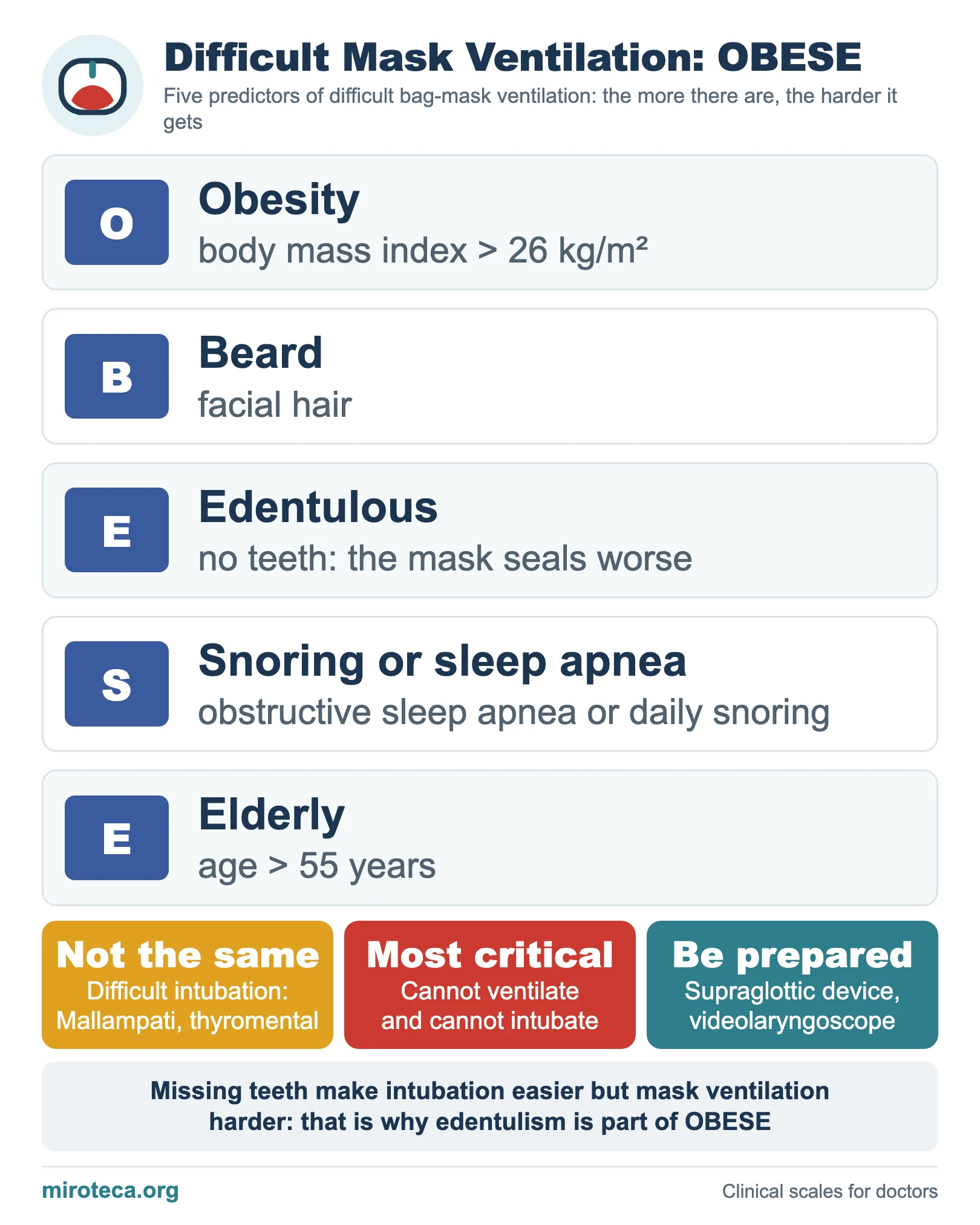
What the chart shows
Before anesthesia it is worth predicting whether mask ventilation will be difficult. The OBESE rule gathers the risk factors; the more are present, the more airway alternatives should be prepared.
The five factors and how they are used
Obesity (body mass index over 26), Beard, Edentulous (no teeth), Snoring or obstructive sleep apnea, and Elderly (over 55 years). They predict difficulty in ventilating, which is the truly dangerous situation: being unable to ventilate and unable to intubate is the most critical scenario.
Do not confuse them with the predictors of difficult intubation, which are different: high Mallampati class, short thyromental distance, limited mouth opening, short neck and limited neck mobility. A trick: missing teeth make intubation easier but ventilation harder (the mask seals worse without teeth), which is why edentulism is in OBESE. Anticipating difficulty allows supraglottic devices and a videolaryngoscope to be at hand.
In exam questions
Short rules: OBESE means predictors of difficult mask ventilation, not of difficult intubation; anticipating the difficulty improves anesthetic safety. Related: ASA physical status.
Keep practicing
This page is the visual summary. To test yourself with real clinical reasoning, Medicinedle, a Wordle-inspired game, gives you one clinical case a day: guess the diagnosis in six tries, with a new clue after every miss. It is free.
Prefer quick questions? The clinical scores quiz gives you 5 case-based questions in about a minute, with the answer explained.