
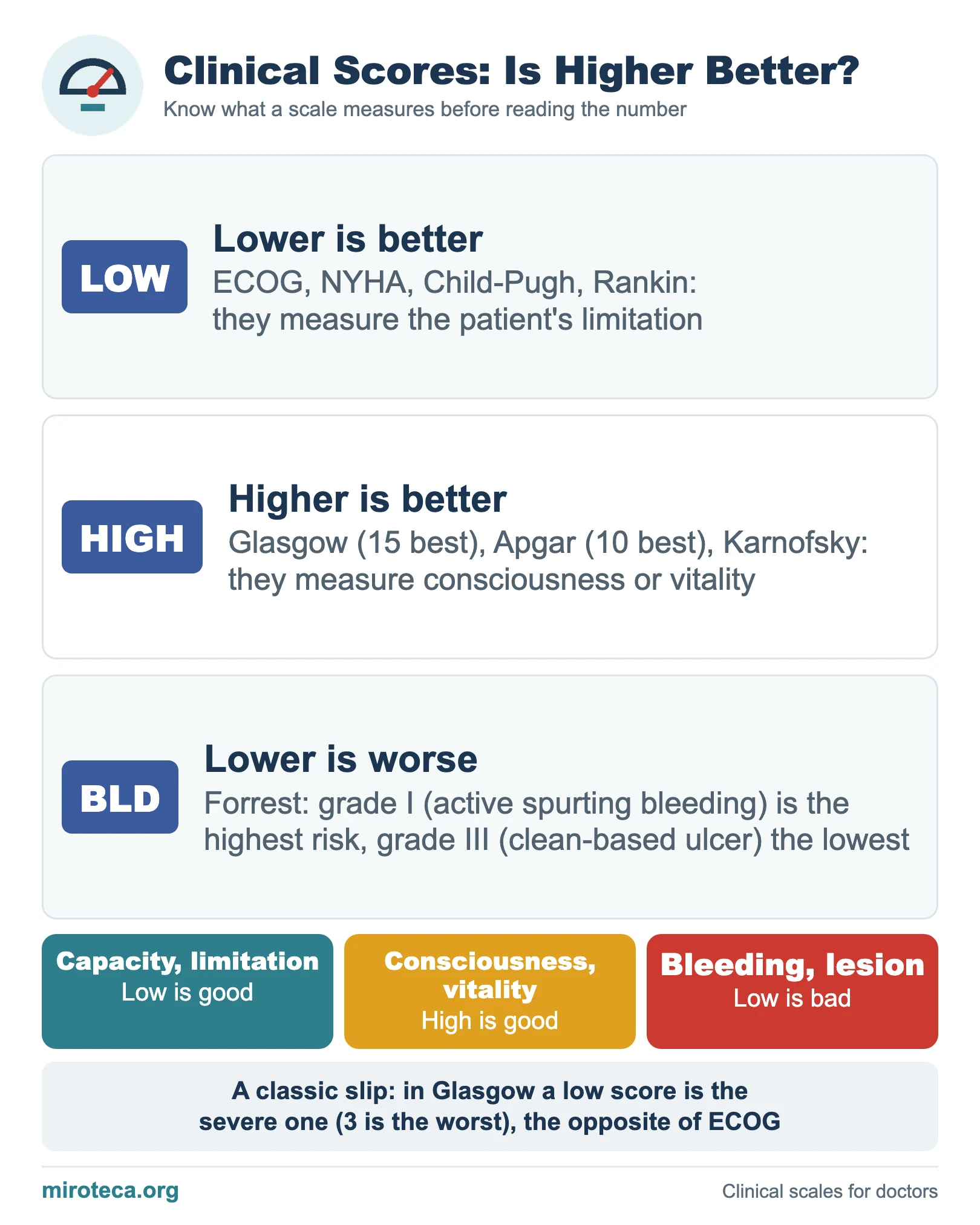
What the chart shows
The silliest exam mistake is reading a scale in the wrong direction ("is more better or worse?"). The quick rule classifies scales by what they measure, and that almost always gets it right.
The rule, with examples
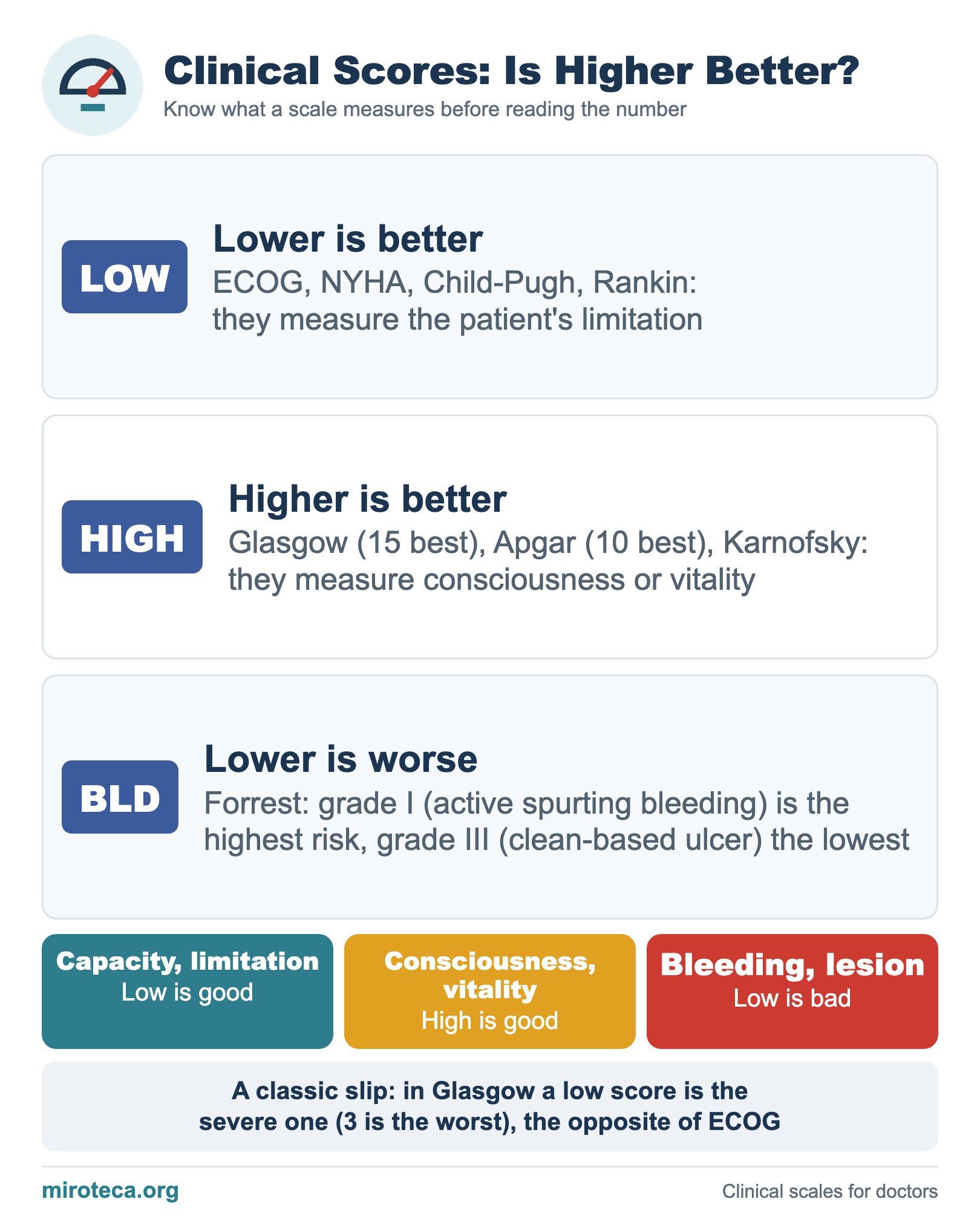
Capacity or limitation, low is good: ECOG, NYHA, Child-Pugh, Rankin. Consciousness or vitality, high is good: Glasgow (15 is best), Apgar (10 is best), Karnofsky. Bleeding or lesion, low is worse: in the Forrest classification, grade I (active spurting bleeding) carries the highest risk and grade III (clean-based ulcer) the lowest.
A case that misleads: in Glasgow the low score is the severe one (3 is the worst), exactly the opposite of ECOG. That is why it pays to fix what the scale measures before interpreting the number.
In exam questions
Short rules: capacity, low is good (ECOG, NYHA); consciousness or vitality, high is good (Glasgow, Apgar); bleeding or lesion, low is bad (Forrest).
Keep practicing
This page is the visual summary. To test yourself with real clinical reasoning, Medicinedle, a Wordle-inspired game, gives you one clinical case a day: guess the diagnosis in six tries, with a new clue after every miss. It is free.
Prefer quick questions? The clinical scores quiz gives you 5 case-based questions in about a minute, with the answer explained.