
What the chart shows
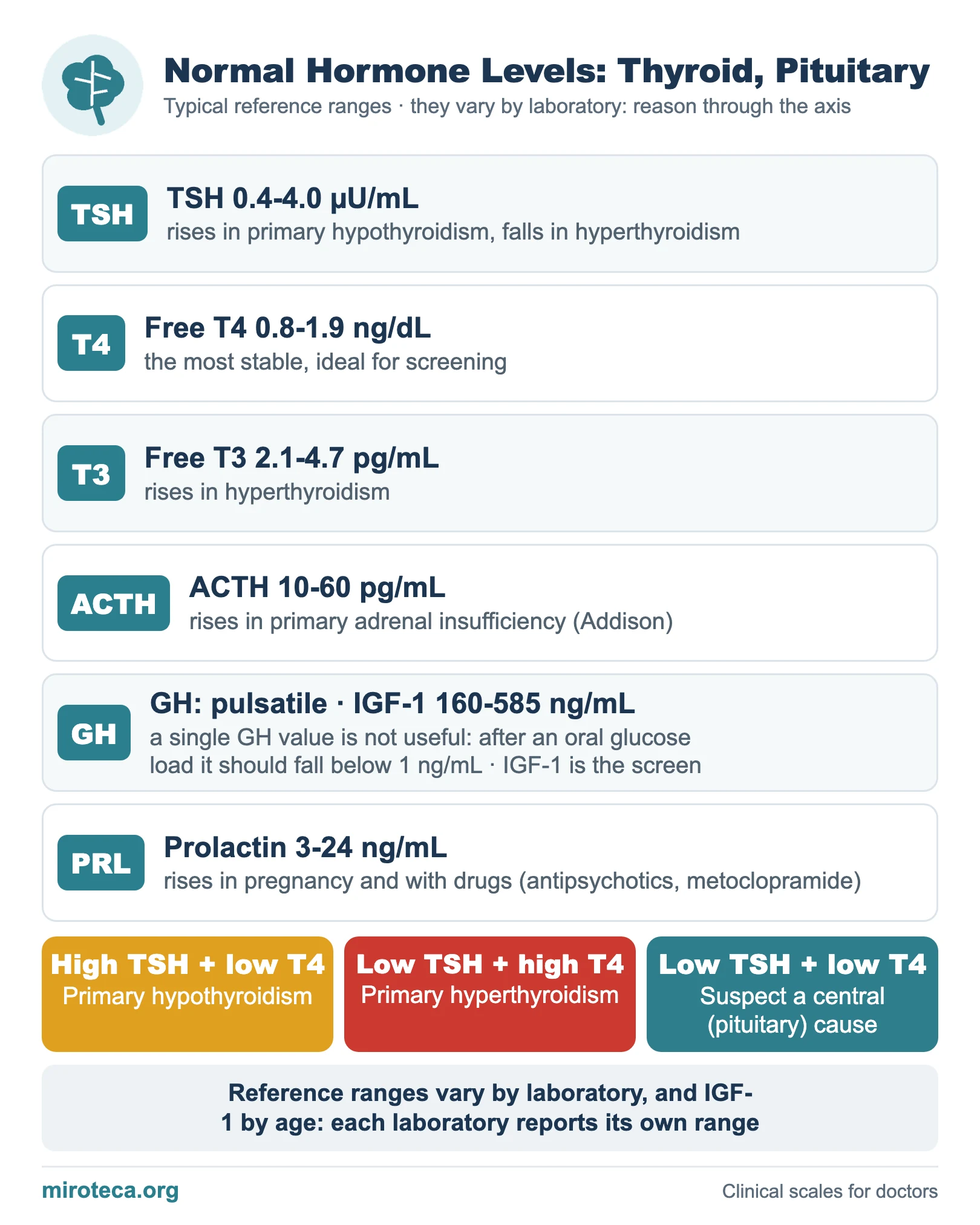
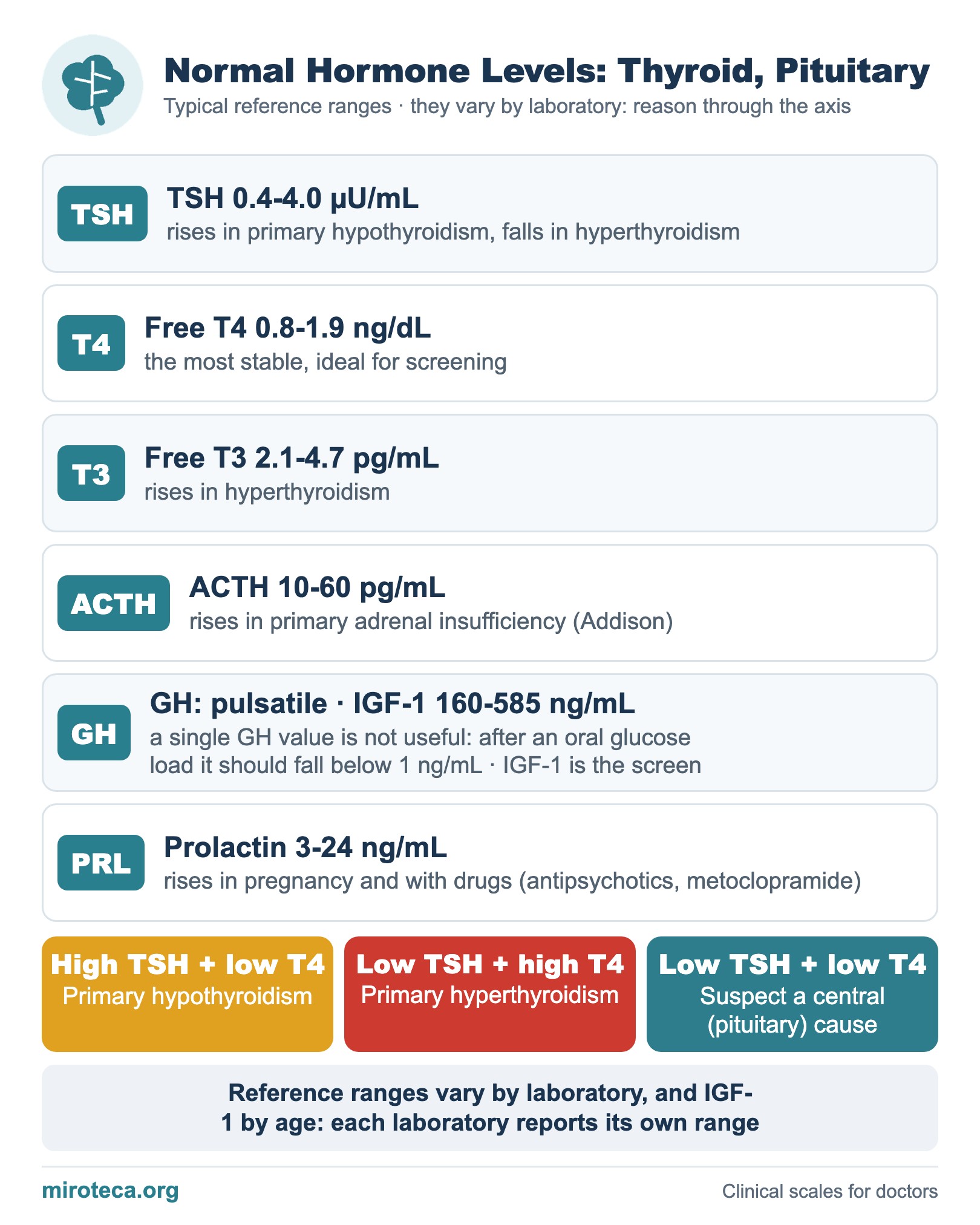
Typical reference ranges of thyroid and pituitary hormones, useful to read endocrine questions quickly. Ranges vary by laboratory (and IGF-1 by age), so what exams reward is reasoning through the pituitary-gland axis rather than memorizing figures.
How to read the axes
TSH is the most sensitive thyroid test and is combined with free T4 to locate the problem. High TSH with low T4: primary hypothyroidism (the thyroid fails). Low TSH with high T4: primary hyperthyroidism. Low or normal TSH with low T4: suspect a central (pituitary) cause.
Details that change the ranges: in pregnancy, beta-hCG stimulates the thyroid and lowers TSH in the first trimester; prolactin rises with pregnancy, stress and drugs (antipsychotics, metoclopramide), worth remembering in hyperprolactinemia without an adenoma. In acromegaly, IGF-1 is the screening test, and the diagnosis is confirmed when GH fails to fall below 1 ng/mL after an oral glucose load (2014 Endocrine Society guideline); a single GH value is not useful because GH is pulsatile. See TSH and acromegaly vs GH deficiency.
In exam questions
Short rules: high TSH means primary hypothyroidism, low TSH means hyperthyroidism; low TSH plus low T4 suggests a pituitary cause; TSH is the best screen of thyroid function.
Keep practicing
This page is the visual summary. To test yourself with real clinical reasoning, Medicinedle, a Wordle-inspired game, gives you one clinical case a day: guess the diagnosis in six tries, with a new clue after every miss. It is free.
Prefer quick questions? The clinical scores quiz gives you 5 case-based questions in about a minute, with the answer explained.