
What the chart shows
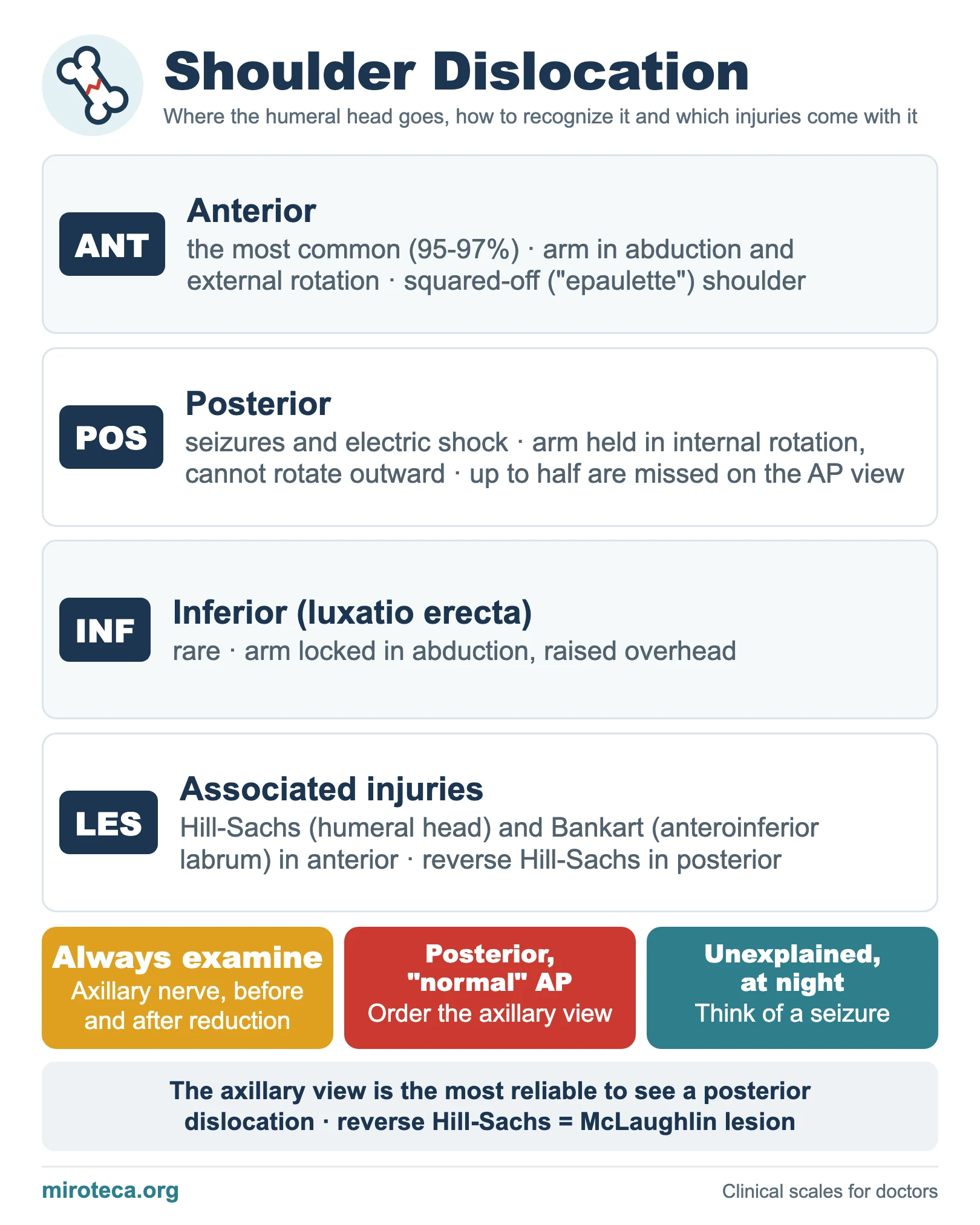
The humeral head can come out forward, backward or downward. Anterior dislocation is by far the most common (about 95-97%): the arm sits in abduction and external rotation and the shoulder loses its rounded contour ("epaulette" sign). Posterior dislocation is uncommon (around 2-5%) and the inferior type, or luxatio erecta, is rare.
Posterior: the one that gets missed
Posterior dislocation is linked to seizures and electric shock: an unexplained dislocation at night should raise the possibility of a seizure. The arm is held in internal rotation and cannot be rotated outward.
On the anteroposterior X-ray it can look almost normal, and up to half are missed at first assessment. The axillary view is the most reliable to see it.
Associated injuries
In anterior dislocation the humeral head strikes the glenoid rim: the Hill-Sachs lesion is a posterosuperior impaction fracture of the humeral head, and the Bankart lesion is an injury of the anteroinferior glenoid labrum. In posterior dislocation the reverse Hill-Sachs (McLaughlin lesion) appears on the anteromedial head.
The axillary nerve is the most frequently injured: the neurovascular examination is recorded before and after reduction.
In exam questions
Short rules: anterior is the common one; a seizure or electric shock suggests posterior; a "normal" AP X-ray with the arm in internal rotation calls for an axillary view; Hill-Sachs and Bankart go with anterior dislocation. See also scaphoid fracture.
Keep practicing
This page is the visual summary. To test yourself with real clinical reasoning, Medicinedle, a Wordle-inspired game, gives you one clinical case a day: guess the diagnosis in six tries, with a new clue after every miss. It is free.
Prefer quick questions? The clinical scores quiz gives you 5 case-based questions in about a minute, with the answer explained.