
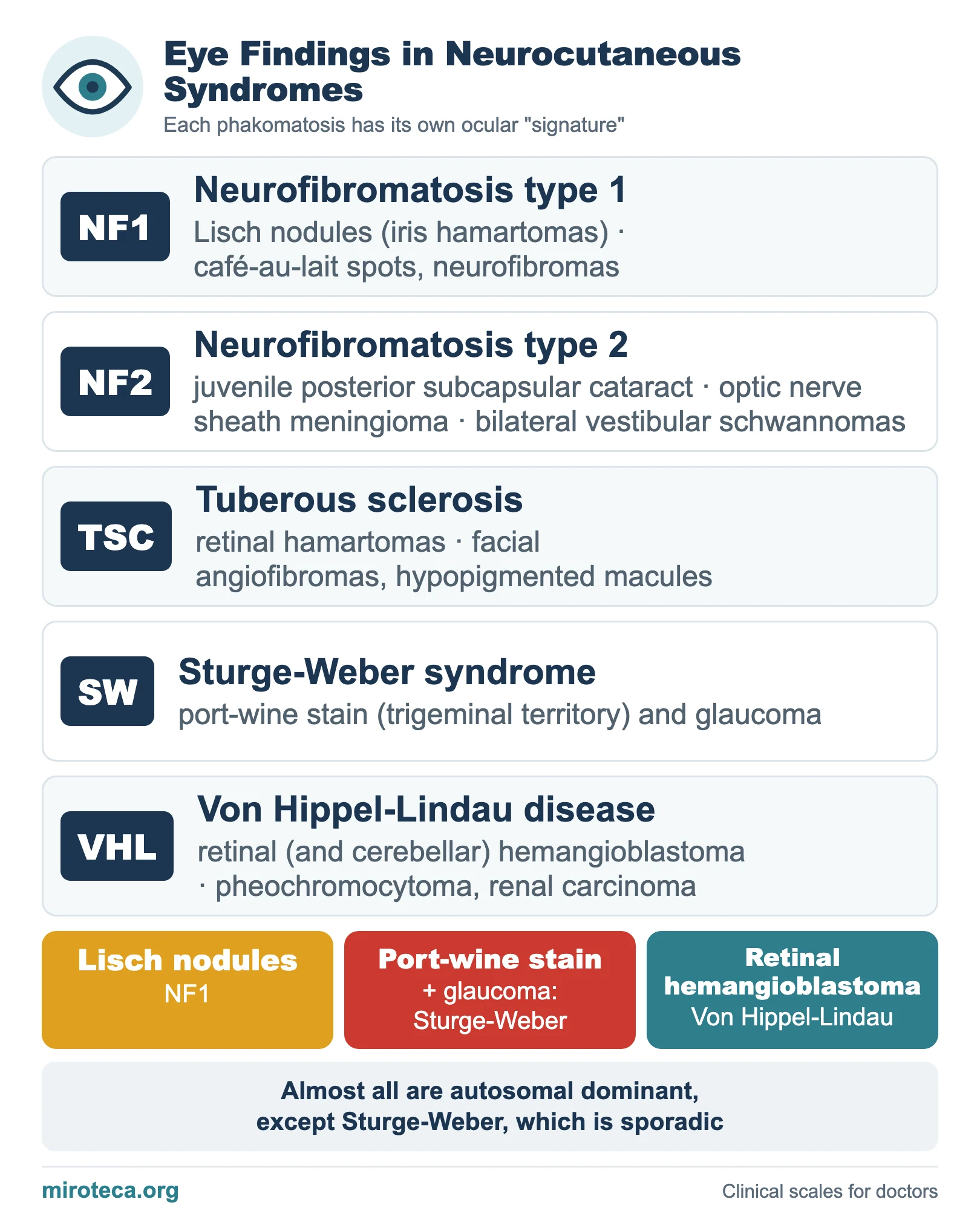
What the chart shows
Each neurocutaneous syndrome (phakomatosis) has an ocular "signature" that exam questions use to identify it from an image or a case. The profitable strategy is to memorize the eye sign as the entry key and, from there, rebuild the rest of the picture (skin, nervous system and inheritance).
Associations to automate
Lisch nodules (iris hamartomas) plus café-au-lait spots and neurofibromas: neurofibromatosis type 1. Juvenile posterior subcapsular cataract, epiretinal membranes or optic nerve sheath meningioma, with bilateral vestibular schwannomas: neurofibromatosis type 2 (optic glioma belongs to type 1). Retinal hamartomas plus facial angiofibromas and hypopigmented macules: tuberous sclerosis. Port-wine facial stain (trigeminal territory) plus glaucoma: Sturge-Weber. Retinal (and cerebellar) hemangioblastoma plus pheochromocytoma and renal carcinoma: Von Hippel-Lindau.
Almost all are inherited in an autosomal dominant pattern, except Sturge-Weber, which is sporadic.
In exam questions
Short rules: Lisch nodules mean NF1; facial angioma plus glaucoma means Sturge-Weber; retinal hemangioblastoma means Von Hippel-Lindau.
Keep practicing
This page is the visual summary. To test yourself with real clinical reasoning, Medicinedle, a Wordle-inspired game, gives you one clinical case a day: guess the diagnosis in six tries, with a new clue after every miss. It is free.
Prefer quick questions? The clinical scores quiz gives you 5 case-based questions in about a minute, with the answer explained.