
What the chart shows
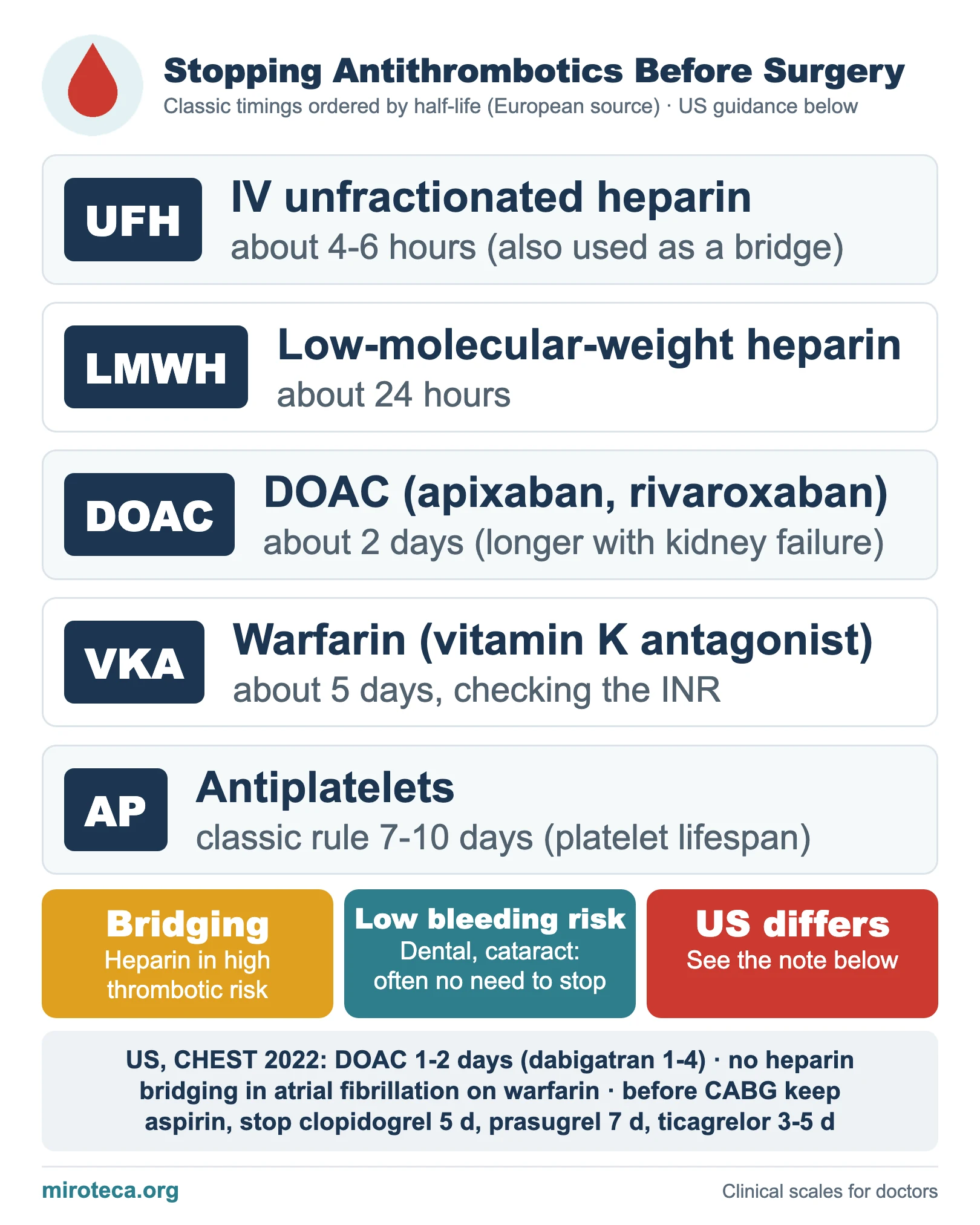
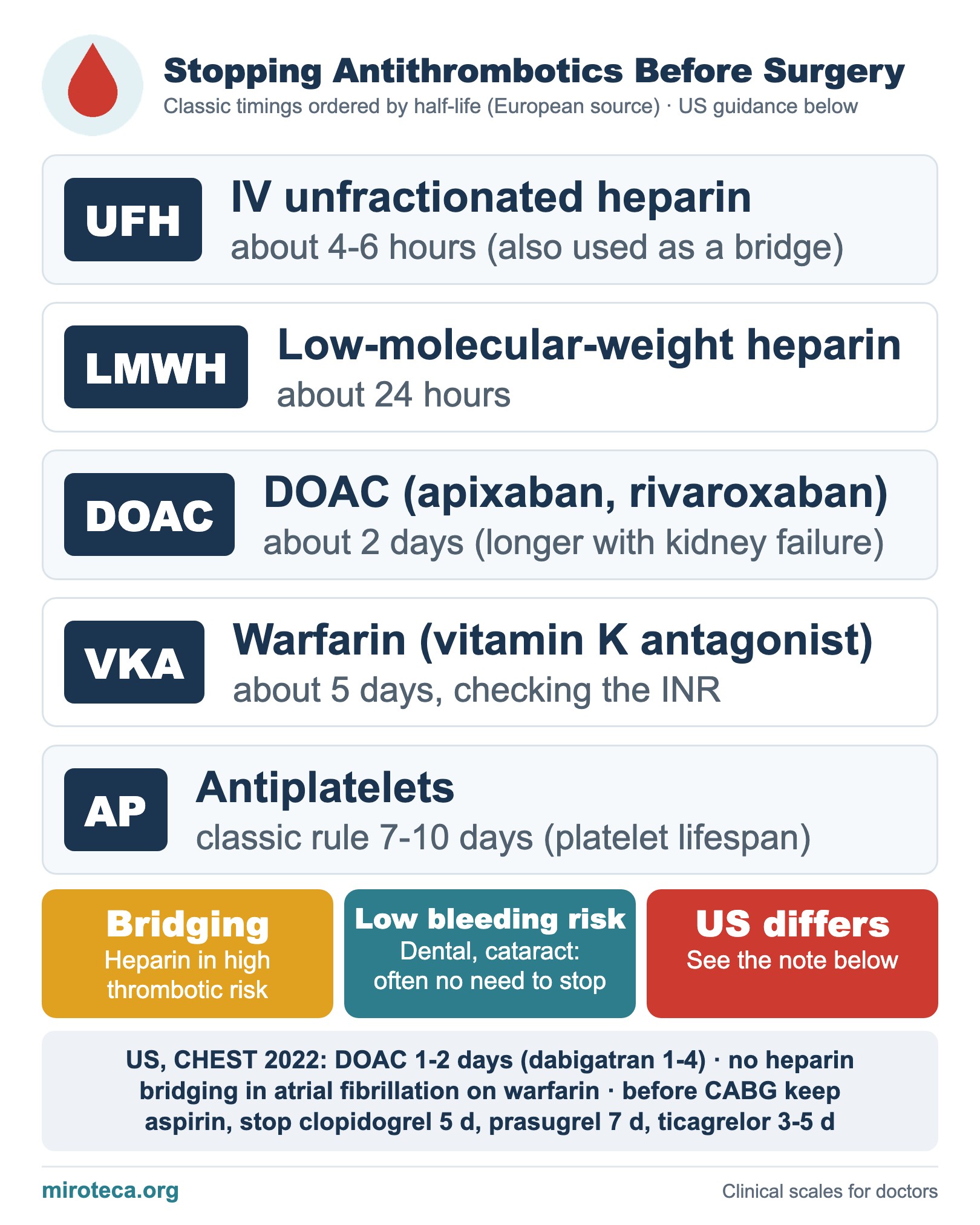
Before surgery with bleeding risk, each antithrombotic has to be stopped with the right notice. The classic rule, taken from the Spanish version of this chart (European practice), is ordered by the half-life of each drug.
The classic timings
IV unfractionated heparin: about 4-6 hours (also used as a bridge). Low-molecular-weight heparin: about 24 hours. DOAC (apixaban, rivaroxaban): about 2 days (longer with kidney failure). Vitamin K antagonist (warfarin): about 5 days, checking the INR. Antiplatelets (aspirin, clopidogrel): 7-10 days (platelet lifespan).
The other half of the topic is bridging: in patients at high thrombotic risk (mechanical valve, atrial fibrillation with a high CHA2DS2-VASc, recent thrombosis) the European source replaces the oral anticoagulant with heparin during the drug-free window. In procedures with low bleeding risk (dental, cataract) the anticoagulant often does not need to be stopped.
US guidance differs (CHEST 2022)
The 2022 American College of Chest Physicians guideline differs in several points. For elective surgery it suggests stopping a DOAC 1 to 2 days before (1 to 4 days for dabigatran), depending on the drug and the bleeding risk. In atrial fibrillation on a vitamin K antagonist, it recommends against heparin bridging. Before coronary bypass surgery, it suggests continuing aspirin and withholding clopidogrel for 5 days, prasugrel for 7 days and ticagrelor for 3 to 5 days. For US exams, these are the timings to use. Summary: AAFP, 2023. Related: CHA2DS2-VASc.
Keep practicing
This page is the visual summary. To test yourself with real clinical reasoning, Medicinedle, a Wordle-inspired game, gives you one clinical case a day: guess the diagnosis in six tries, with a new clue after every miss. It is free.
Prefer quick questions? The clinical scores quiz gives you 5 case-based questions in about a minute, with the answer explained.