
What the chart shows
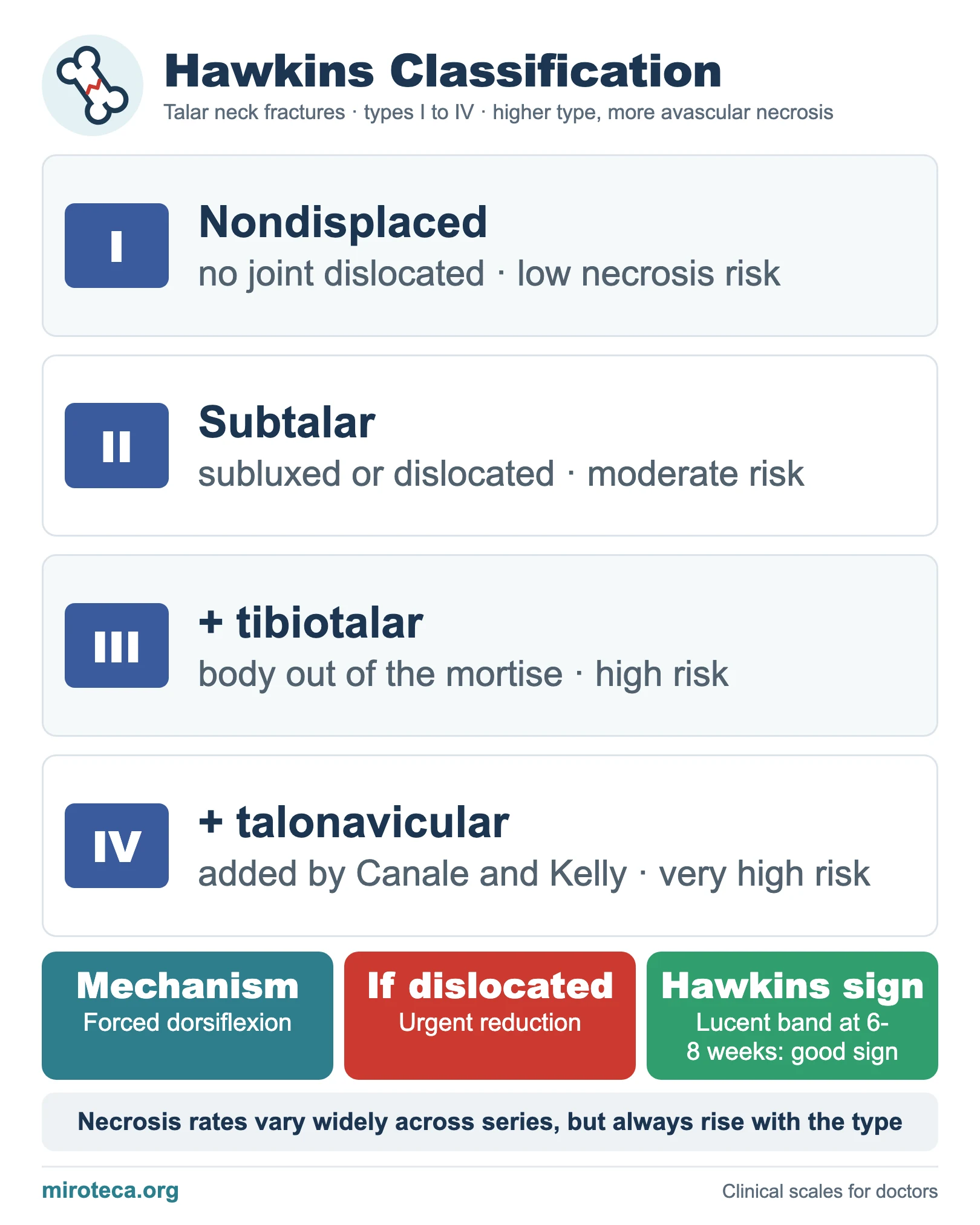
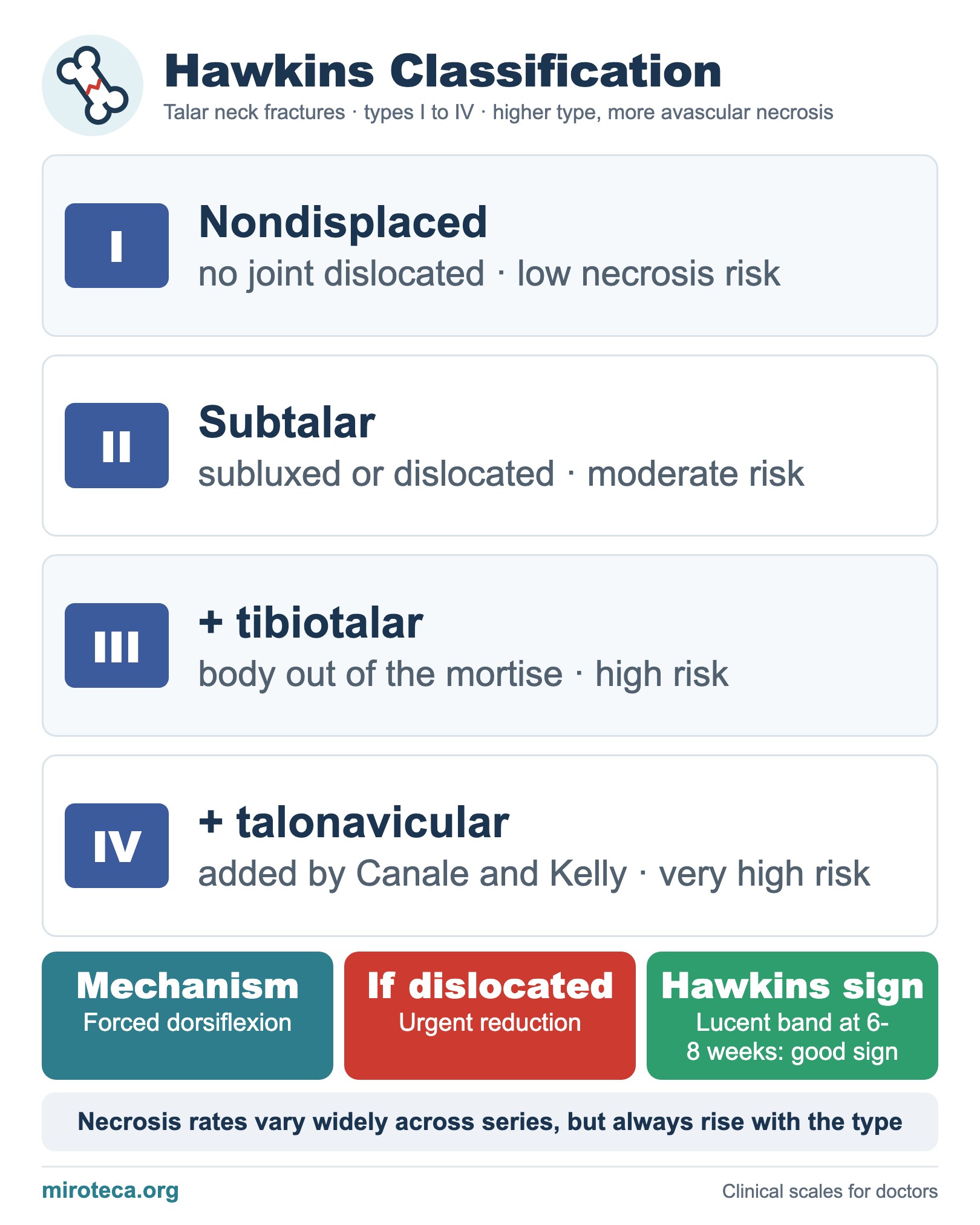
The Hawkins classification describes talar neck fractures by how many neighboring joints are dislocated. Hawkins described three types in 1970; Canale and Kelly added type IV in 1978. It is mainly prognostic: the talus has a fragile blood supply, and the more displacement, the higher the risk of avascular necrosis.
The detail that settles it
Type I is nondisplaced, type II adds subtalar subluxation or dislocation, type III adds tibiotalar dislocation and type IV adds talonavicular dislocation. Classic ranges for necrosis are about 0-15%, 20-50%, 20-100% and 70-100%, but published series vary widely; a 2013 systematic review found an overall rate of 33%. Dislocated fractures need urgent reduction to protect the skin and blood supply.
In exam questions
The Hawkins sign is a subchondral lucent band in the talar dome at 6-8 weeks: it shows the bone is vascularized and makes necrosis unlikely. Its absence does not confirm necrosis. The usual mechanism is forced dorsiflexion (car pedal, fall from height).
Keep practicing
This page is the visual summary. To test yourself with real clinical reasoning, Medicinedle, a Wordle-inspired game, gives you one clinical case a day: guess the diagnosis in six tries, with a new clue after every miss. It is free.
Prefer quick questions? The clinical scores quiz gives you 5 case-based questions in about a minute, with the answer explained.