What the chart shows
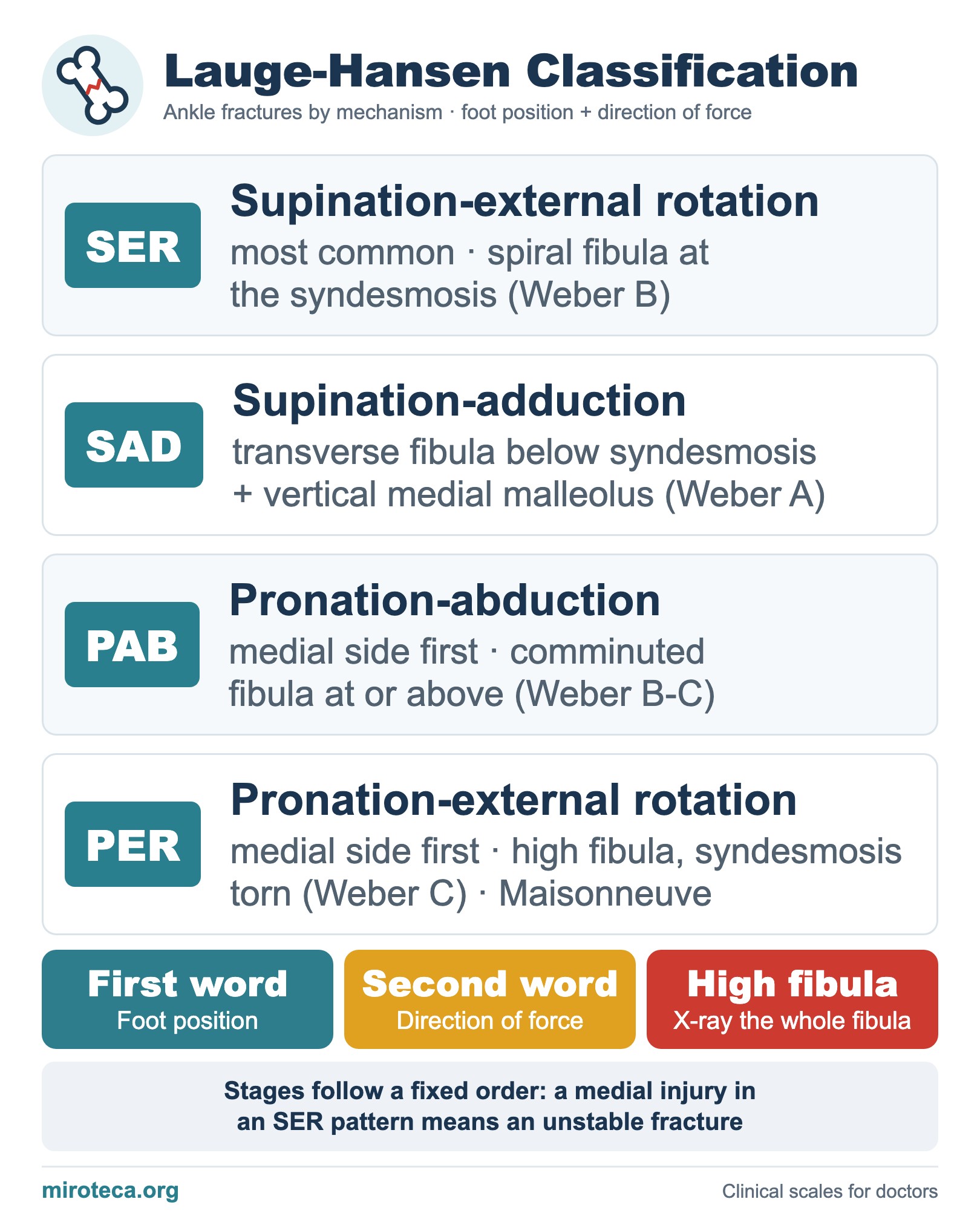
The Lauge-Hansen classification describes ankle fractures by mechanism: the first word is the position of the foot at the time of injury (supination or pronation) and the second the direction of the force (external rotation, adduction or abduction). Each type has stages that occur in a fixed order.
The detail that settles it
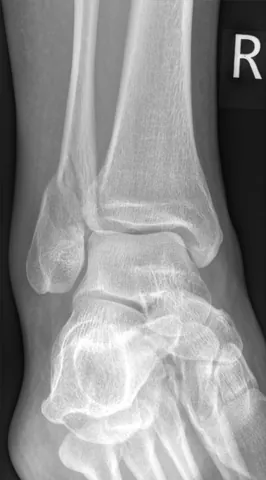
Supination-external rotation (SER) is the most common: a spiral fibular fracture at the level of the syndesmosis (Weber B). An SER 2 with no medial injury is usually stable; SER 4, with a medial malleolus fracture or deltoid rupture, is unstable. The fibula reveals the mechanism: transverse and low (SAD), spiral at the syndesmosis (SER), comminuted with a butterfly fragment (PAB) or high (PER).
In exam questions
Medial ankle pain without a distal fibular fracture calls for palpation and X-ray of the whole fibula: a high fibular fracture with syndesmotic disruption is a Maisonneuve fracture (PER pattern). Lauge-Hansen complements the Weber classification, which only looks at the level of the fibular fracture.
Keep practicing
This page is the visual summary. To test yourself with real clinical reasoning, Medicinedle, a Wordle-inspired game, gives you one clinical case a day: guess the diagnosis in six tries, with a new clue after every miss. It is free.
Prefer quick questions? The clinical scores quiz gives you 5 case-based questions in about a minute, with the answer explained.