What the chart shows
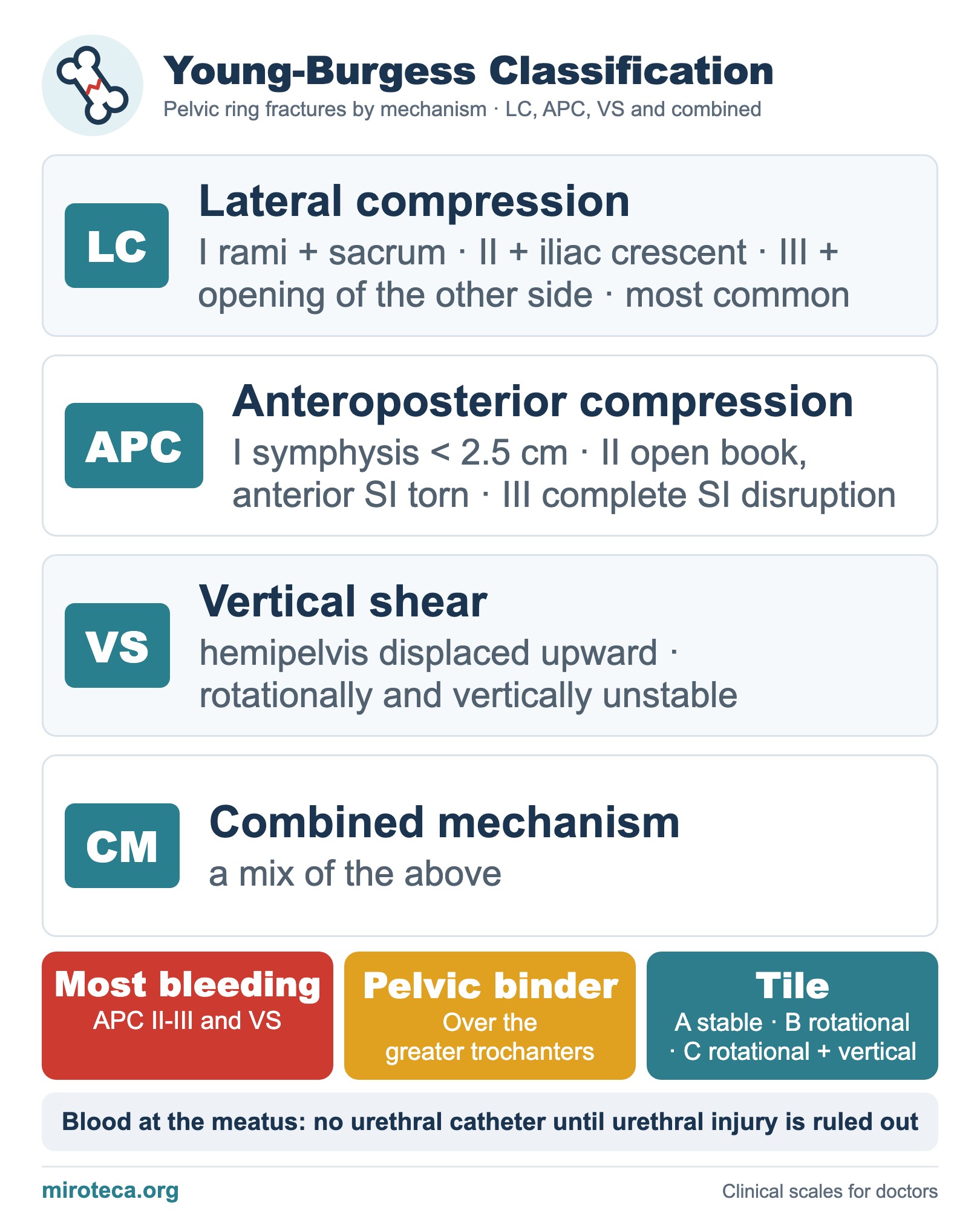
The Young-Burgess classification describes pelvic ring injuries by the direction of force: lateral compression (LC), anteroposterior compression (APC), vertical shear (VS) and combined mechanism (CM). LC and APC are graded I to III. The Tile classification groups the same injuries by stability: A stable, B rotationally unstable but vertically stable, C rotationally and vertically unstable.
The detail that settles it
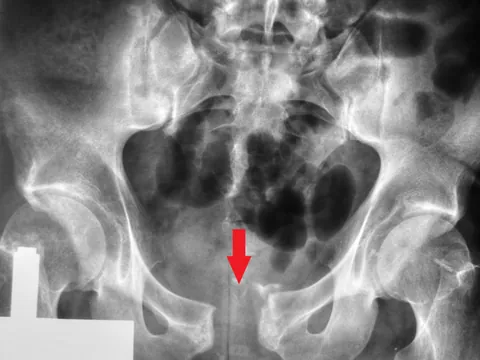
APC I widens the symphysis less than 2.5 cm with intact sacroiliac ligaments (some sources use 2 cm); APC II is the open book, with anterior sacroiliac disruption; APC III is complete sacroiliac disruption. LC I combines rami fractures and sacral compression; LC II adds an iliac crescent fracture; LC III adds an opening injury on the other side (windswept pelvis). APC II-III and VS injuries open the ring and tend to bleed the most.
In exam questions
A pelvic binder is centered over the greater trochanters, not the iliac crests. Blood at the urethral meatus in a man with a pelvic fracture means no urethral catheter until urethral injury is ruled out (retrograde urethrogram). In hypotension, look for other bleeding sources too.
Keep practicing
This page is the visual summary. To test yourself with real clinical reasoning, Medicinedle, a Wordle-inspired game, gives you one clinical case a day: guess the diagnosis in six tries, with a new clue after every miss. It is free.
Prefer quick questions? The clinical scores quiz gives you 5 case-based questions in about a minute, with the answer explained.