What the chart shows
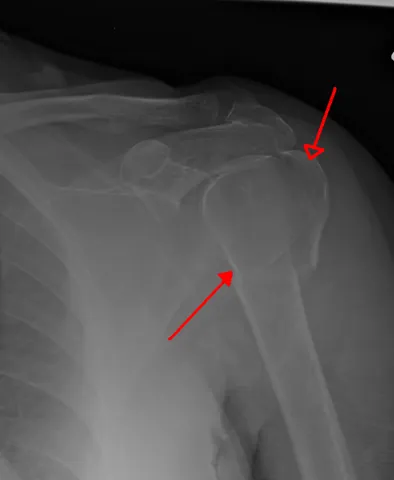
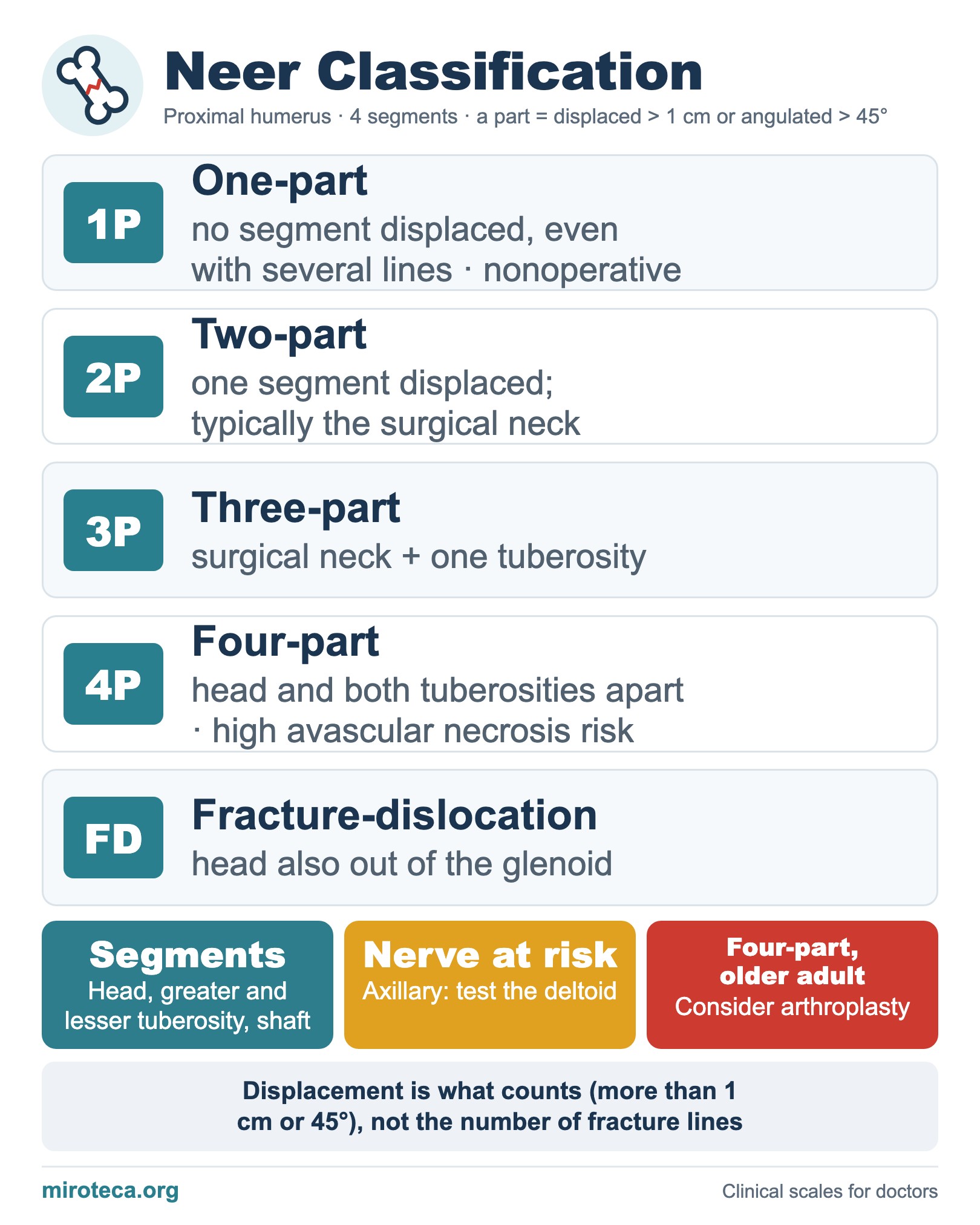
The Neer classification sorts proximal humerus fractures by how many of four segments are displaced: the humeral head (articular surface), the greater tuberosity, the lesser tuberosity and the shaft. A segment counts as a displaced part when it is separated by more than 1 cm or angulated more than 45 degrees.
The detail that settles it
It counts displaced parts, not fracture lines: a fracture with five lines and no displacement is still a one-part fracture, usually treated in a sling with early motion. In four-part fractures the head loses its blood supply, so the risk of avascular necrosis is high and arthroplasty is often considered in older adults.
In exam questions
The axillary nerve wraps around the surgical neck and is the nerve most often injured: test sensation over the lateral shoulder and deltoid contraction. An axillary or scapular Y view is needed to rule out an associated dislocation.
Keep practicing
This page is the visual summary. To test yourself with real clinical reasoning, Medicinedle, a Wordle-inspired game, gives you one clinical case a day: guess the diagnosis in six tries, with a new clue after every miss. It is free.
Prefer quick questions? The clinical scores quiz gives you 5 case-based questions in about a minute, with the answer explained.