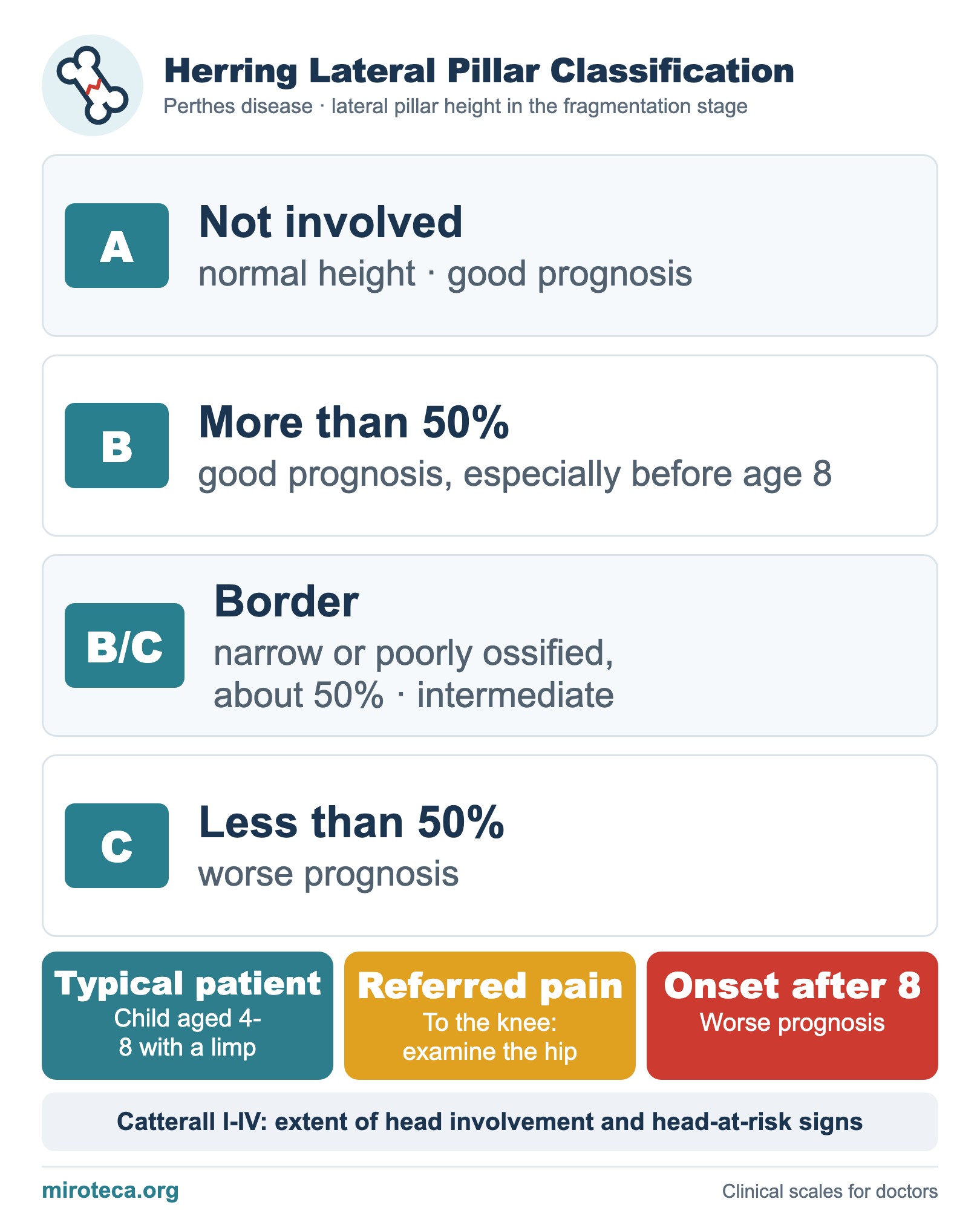
What the chart shows
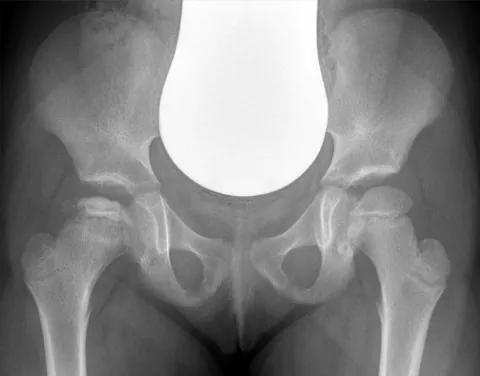
The Herring lateral pillar classification describes Legg-Calve-Perthes disease (idiopathic avascular necrosis of the femoral head in children) by how much height the lateral pillar of the epiphysis keeps on the AP X-ray during the fragmentation stage. With age at onset, it is the most used prognostic tool.
The detail that settles it
Group A: lateral pillar not involved. Group B: more than 50% of its height maintained. B/C border: narrow, poorly ossified or slightly depressed pillar at about 50%. Group C: less than 50%. Onset after age 8 worsens the prognosis; groups B (older children) and B/C are where containment surgery is considered, while group C does worse whatever the treatment.
In exam questions
The typical patient is a boy aged 4 to 8 with a limp and pain often referred to the knee: always examine the hip (limited internal rotation and abduction). The older Catterall classification grouped hips I to IV by the extent of head involvement and described head-at-risk signs.
Keep practicing
This page is the visual summary. To test yourself with real clinical reasoning, Medicinedle, a Wordle-inspired game, gives you one clinical case a day: guess the diagnosis in six tries, with a new clue after every miss. It is free.
Prefer quick questions? The clinical scores quiz gives you 5 case-based questions in about a minute, with the answer explained.